

The Apostle To The Gentiles
Paul was a fellow member of the Jewish Pharisees in the 1st century CE, who experienced a revelation of the resurrected Jesus Christ. In this vision, Jesus commissioned him to be the apostle (herald) to the Gentiles (non-Jews). After this experience, he traveled widely throughout the Roman Empire, spreading the "skillful news" that Jesus would shortly return from heaven and usher in the kingdom of God on globe.
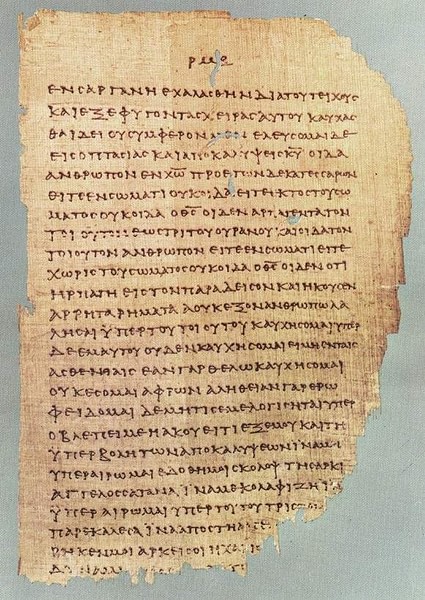
Page of Early Pauline Espitles
In the New Testament, we accept 14 letters traditionally assigned to Paul, simply the scholarly consensus now recognizes that of the 14, vii were written by Paul:
- 1 Thessalonians
- Galatians
- Philemon
- Philippians
- 1 & two Corinthians
- Romans
2 Thessalonians, Ephesians, and Colossians remain debatable among some scholars. The other major letters (1 &2 Timothy and Titus) were near probable written by disciples of Paul's, using his name to carry authorization. The letters that have survived range between 52 and threescore CE, and although we cannot pinpoint when Paul's letters were collected, Clement, a bishop in Rome in the 90s CE, quoted from i Corinthians.
The Nature of the Letters
Information technology is in Paul's letters that the name Jesus is combined with Christ, the Greek for the Hebrew messiah ("anointed one").
We empathize these letters to exist circumstantial. They were not written equally systematic theology or every bit treatises on Christianity. The letters are responses to specific bug and circumstances as they arose in his communities. Paul spent time in cities establishing a group and then moved on. He received letters and sometimes reports with detailed questions or advice on how to settle conflicts. Unfortunately, when Paul'southward letters were saved and circulated, the original letters from the communities were not preserved. The reconstruction of the original problems tin can only be adamant by Paul'southward responses.
Follow the states on Youtube!
Known equally the most famous convert in history (from the Acts of the Apostles), Paul did non really undergo conversion. Conversion assumes changing from one religious organization to another, but at the fourth dimension, at that place was no Christian arrangement for him to convert to. Paul himself was ambiguous when it came to his self-identity:
To the Jews I became similar a Jew... To those under the police I became like i under the law (though I myself am non under the law) ... To those not having the constabulary I became similar one not having the law (though I am not free from God's police but am under Christ's police force) ... I have become all things to all people. (i Corinthians ix:20-22)
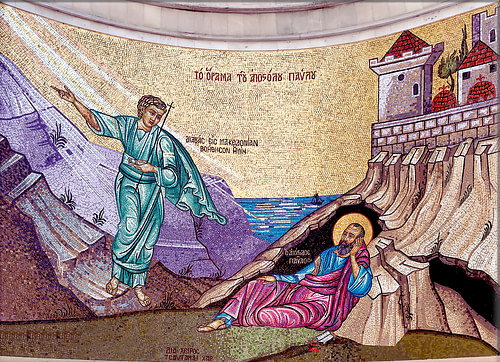
Apostle Paul Mosaic
In relation to what happened to Paul, information technology is better to follow what he says, in that he was 'called'. This is the tradition of the way in which the Prophets of Israel were chosen to their individual missions.
I want you to know, brothers and sisters, that the gospel I preached is not of human origin. I did not receive it from any human being, nor was I taught it; rather, I received information technology by revelation from Jesus Christ. (Galatians one:eleven-12).
Paul argued that this experience gave him as much authority as the original circle in Jerusalem (Peter, James, and John). Paul's call to exist the Apostle to the Gentiles was shocking because, as he freely admitted, he had previously "persecuted the church of God" (Galatians ane:xiii). He never actually explained what he did, nor why he did it. It is in Paul'south letters that the name Jesus is combined with Christ, the Greek for the Hebrew messiah ("all-powerful i"). Understood as a title, "Jesus the Christ", it became common as a phrase that indicated his identity and function.
The Access of Gentiles
Both the Acts of the Apostles and Paul'southward letter to the Galatians describe a meeting held in Jerusalem to resolve an unexpected occurrence. When missionaries took the teachings of Jesus of Nazareth to other cities, they plant that Gentiles wanted to join. 'Gentiles' is the broad term for anyone who was not Jewish. Many non-Jews often participated in the synagogues in the cities, as they admired Jewish teachings and ethics. Known equally "God-fearers" in the Acts of the Apostles (those who respected the God of Israel), they would accept been familiar with the scriptural allusions in the teachings of the followers of Jesus.
The leaders had to determine if these non-Jews could bring together the motility without becoming Jews get-go. Judaism had unique identity markers: circumcision, dietary laws, and Sabbath observance from the Law of Moses. At the meeting, it was decided that these people did non have to undergo circumcision, nor the other identity problems, just did accept to abjure from the things "polluted by idols" (Acts 15:xx), and avert whatsoever meat from an animal strangled or killed in the wild. They likewise had to cease their "sexual immorality" which may exist a reference to following Jewish incest laws and non the ones of the ascendant culture. Paul felt vindicated by this decision because that is what he had been education in his communities for years.
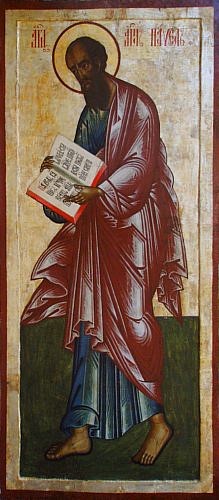
Paul the Apostle
Although a conclusion was made in Jerusalem, plainly the issue of Gentile inclusion continued to be debated in the communities. This trouble is found in all of Paul's letters. In Galatians, Paul opens the letter of the alphabet by complaining that after he left the region, false apostles came and taught "a different gospel" (Galatians 1:half-dozen). In other words, some members connected to insist that Gentiles become Jews first. Paul's arguments for the inclusion of Gentiles without becoming Jews included polemic against the false apostles which could exist quite stringent at times. This led to a misconception that Paul taught against his former faith in light of the new one.
Simply in relation to ethnic identity, the Law of Moses was only directed to Jews; Gentiles were never expected to prefer Jewish identity markers. The Prophets of Israel all predicted that in the final days, some Gentiles would turn and worship the God of Israel. They would go part of State of israel just retain their ethnic identity every bit Gentiles. Everything Paul wrote about Judaism and the Gentiles was related to this. The turning of the Gentiles convinced Paul that what the Prophets had foretold was manifest in the communities of believers.
Paul'south Eschatology & Ordeals
Paul saw himself & his boyfriend believers as the last generation of the old order.
When reading Paul's letters, it is important to remember that in the context of Paul's missions, he worked within a express timeframe. Jesus had taught the imminence of the kingdom of God roughly 20 years before. For Paul, information technology was all the same to be manifest, although "the time is short" (1 Corinthians 7:29). Paul was non establishing a new faith; he believed that his generation was the last earlier the finish fourth dimension when the universe would be transformed and all social conventions would exist changed. Paul adopted an early Christian claim known as the parousia ("2nd appearance") that Christ would return to earth and complete the end-fourth dimension prophecies. Paul saw himself and his boyfriend believers as the concluding generation of the old guild.
From Paul's letters, nosotros sympathise that when Paul entered a city he began alluring followers, either from synagogue communities or the forum. Although all English Bibles interpret these communities as "churches", there were no church building buildings for approximately 300 years. "Church" is translated from the Greek ecclesia and meant "assembly". Cities of the empire had assemblies of local citizens who made up the authorities in the form of elected magistrates, and Paul apparently applied this model. His followers met in individual houses, and he mentions many of the people who opened their houses for meetings in his letters.
In two Corinthians, Paul complained most not getting the same respect as the other apostles:
Are they servants of Christ? (I am out of my mind to talk similar this.) I am more than. I take worked much harder, been in prison more than ofttimes, been flogged more severely, and been exposed to death once more and over again. Five times I received from the Jews the twoscore lashes minus one. Iii times I was browbeaten with rods, once I was pelted with stones, three times I was shipwrecked, I spent a night and a day in the open sea... (2 Cor. 11:23-25).
Lashes were role of synagogue punishments for violations of Mosaic Law. Paul never provided details on this. Rods were a Roman punishment for civil disorder. Paul referred to his constant sufferings throughout his letters to validate how much he had labored for the benefit of believers.
Galatians
In this letter, Paul introduced what became one of his nearly famous teachings: "a person is not justified by the works of the law, but by faith in Jesus Christ" (Galatians 2:sixteen) English Bibles translate the Greek pistis every bit "religion" but information technology meant "loyalty". In this sense, loyalty to the teachings of Christ as transmitted through Paul. (This is where Martin Luther obtained his concept of faith lone leading to salvation.) Yet, what Paul meant was that Gentiles are admitted without "the works of the Constabulary" referring to those physical barriers that kept Jews and Gentiles apart.
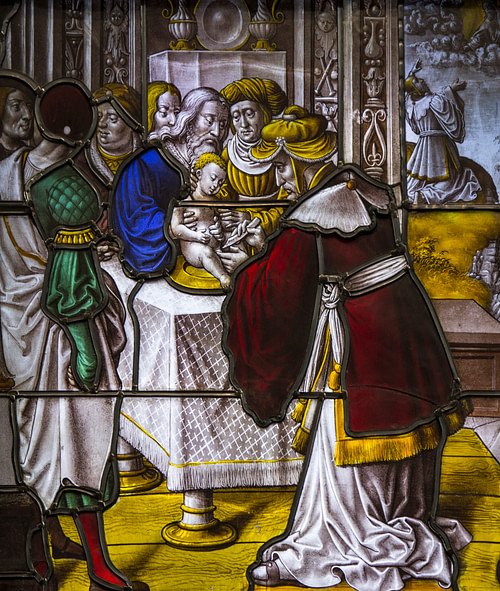
Circumcision
In his letters, Paul consistently tried to eliminate social and cultural barriers in the group. One time admitted, Gentiles had to follow the precepts of the Mosaic Police. As a Pharisee, the Police force of Moses held neat pregnant for him, and he repeatedly applied quotations from the Law of Moses in relation to ethics and behavior. He could never say that the Law was not good, just when information technology came to the Gentiles, the physical rituals of Moses were not required. In Galatians, Paul wrote that God gave the Constabulary as a pedagogus (a tutor, a guide), to define sin. Without the Police force, we could non know right from wrong. But now, Christ had come as the teleos (end or goal) of the Law.
"Justified" was i of those Greek words that had several meanings. In English Bibles, it is sometimes translated equally "justified" and sometimes as "righteoused", to be alleged "righteous". Paul's concept was more fully explained in his letter to the Romans. He presented the decease of Jesus as an amende for the sin of Adam. Adam's sin resulted in the penalization of human death, and Christ's expiry resulted in eternal life (resurrection). Believers were acquitted (justified) of this punishment; Paul believed his generation would literally not endure physical decease. The later Church retained the concept of parousia, but at present at a future date. Christians would notwithstanding physically die but had the opportunity for eternal life in heaven.
one Thessalonians
Ane of the earliest of Paul's letters, the customs at Thessalonica had written to him in some distress. Members of the community had died earlier the return of Christ. Paul wrote back:
According to the Lord'southward word, we tell you that we who are nonetheless alive, who are left until the coming of the Lord, volition certainly non precede those who take fallen asleep. For the Lord himself volition come downward from heaven, with a loud control, with the voice of the archangel and with the trumpet call of God, and the expressionless in Christ will rising first. After that, we who are yet alive and are left will be caught upwards together with them in the clouds to run into the Lord in the air. And so nosotros will be with the Lord forever. Therefore encourage one another with these words. (1 Thessalonians iv:fifteen-18)
This passage was later adopted by Christian believers in the 17th century to posit the concept known as "the rapture" or the taking of good Christians to heaven before the violence of the final days began as described in the Book of Revelation.
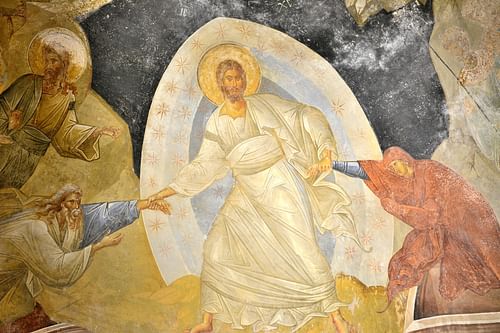
Anastasis Scene in Chora Museum
Philippians
Paul presented a confusing combination about Jesus: Jesus was both a divine pre-real effigy nowadays at the creation and "a descendant of David ... who through the Spirit of holiness was appointed the Son of God in power by his resurrection from the dead" (Romans 1:three). An early hymn recited by Paul is establish in Philippians 2:vi-eleven:
[Jesus] Who, beingness in the very nature God, did not consider equality with God something to exist used to his own advantage; rather, he made himself zilch past taking the very nature of a servant, beingness made in homo likeness. And beingness found in appearance as a man, he humbled himself by condign obedient to decease—fifty-fifty death on a cantankerous! Therefore, God also highly exalted him and gave him the name that is to a higher place every name, so that at the name of Jesus every knee should bend, in sky and on globe and under the world, and every natural language should confess that Jesus Christ is Lord, to the celebrity of God the male parent.
"... and gave him the name that is above every proper name" is the Tetragrammaton (YHWH), the name of God. That "every knee joint should bend" meant worship in an historic period-old concept of bowing down before images of various gods. Philippians ii:6-11 is essentially an exegesis (interpretation) of Isaiah 45:52-53, known as the "suffering retainer" passages. The suffering retainer humbled himself in obedience, suffered, and died, only to exist resurrected and exalted above all others and placed beside God on the heavenly throne. Some Jews had interpreted the passage in Isaiah to mean that God had manifested himself in this servant. That God was literally present in Jesus was later canonized in the concept of the trinity, with the First Council of Nicaea in 325 CE declaring that God and Jesus were of identical essence.
Christian believers worshipping Jesus equally God and Paul'south demand that Gentiles terminate idolatry most likely acquired problems, which led to his ordeals in the synagogues every bit well as in the forums.
1 & two Corinthians
1 Corinthians xiii contains Paul's lecture on the true meaning of love for each other in the community.
The Corinthian correspondence is a fascinating window on 1 of the earliest Christian communities. Afterwards Paul left the city, he had reports that the Corinthians had misunderstood many of his teachings. Throughout one Corinthians, he admonished the community for establishing factions or splinter groups. They were divided over who was better for having been baptized by either Paul, Apollos (a Christian from Alexandria), or Peter. They were suing each other in the public police courts and were confused over whether widows should remarry. They were also in competition over who had the best "gifts of the spirit" (speaking in tongues, prophecy, healing), and the remembrance of the Lord'due south supper had become reduced to fighting over food and beverage. Some members had as well begun teaching confronting the concept of the resurrection of the dead.
As Paul addressed all these problems, the alphabetic character contains what would become some of the virtually spiritual, enlightening elements of Christian teaching. 1 Corinthians 13 contains Paul'south lecture on the true pregnant of love for each other in the customs. 1 Corinthians 15 is the only place in the New Attestation that described what resurrection will be like, every bit believers are transformed into spiritual bodies to welcome the returning Christ.
2 Corinthians is an esoteric, self-reflection on Paul's experience of having an out-of-the-body journey to the heavens to be shown secrets of the final days. This letter incorporates philosophical views and has led many to apply it in analyses of the mystical Paul.
Romans
This letter of the alphabet is i of his about complete as he was introducing himself to the Romans and simultaneously explaining his teachings. Many of the bug from the other letters are repeated and more fully worked out in this final missive that encapsulates Pauline theology. In Romans vii he reflected on why humans sin. In a complicated passage, he claimed that despite the Law (knowing correct from incorrect), we sin because the power of sin is an agile force within us. Christ's decease and resurrection (taking on the power of sin), released those from this power who have faith in Christ.
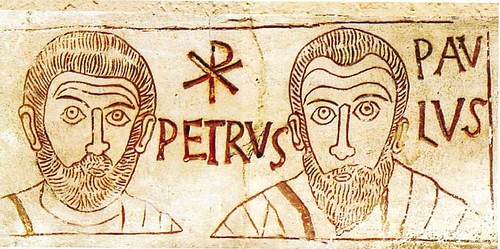
Saints Peter and Paul, from a Crypt Etching
In Romans, we find one of the few times that he addressed his fellow Jews:
I have great sorrow and unceasing ache in my center. For I could wish that I myself were cursed and cut off from Christ for the sake of my people, those of my ain race, the people of Israel. Theirs is the adoption to sonship; theirs the divine glory, the covenants, the receiving of the law, the temple worship and the promises. (Romans 9:ii-4).
Once the Jews saw what has happened to the Gentiles, they will ultimately repent and take the good news of Christ and believe. In the meantime, the Gentiles are not to gloat over their good fortune, as they are secondary.
I exercise not want yous to be ignorant of this mystery, brothers and sisters, so that you may not be complacent: Israel has experienced a hardening in part until the total number of the Gentiles has come in, and in this manner all Israel volition be saved. (Romans 11:25-26)
Paul did not indicate a timeframe nor any idea of a quota, but this was Paul's self-understanding of his role in salvation: the kingdom awaited Paul'due south crucial piece of work among the Gentiles and and so the Jews would come to believe.
In terms of influence and numbers, we have no definite figures for how many people Paul helped to become the new believers. But in the heart of the 2nd century, Paul's teaching became the basis of Christian dogma. In quoting Paul, they consistently referred to him equally "the Apostle", a championship he would have been proud of.
This article has been reviewed for accurateness, reliability and adherence to bookish standards prior to publication.

The Apostle To The Gentiles,
Source: https://www.worldhistory.org/article/1841/the-letters-of-paul-the-apostle-to-the-gentiles/
Posted by: eilermanfriltang83.blogspot.com
0 Response to "The Apostle To The Gentiles"
Post a Comment